




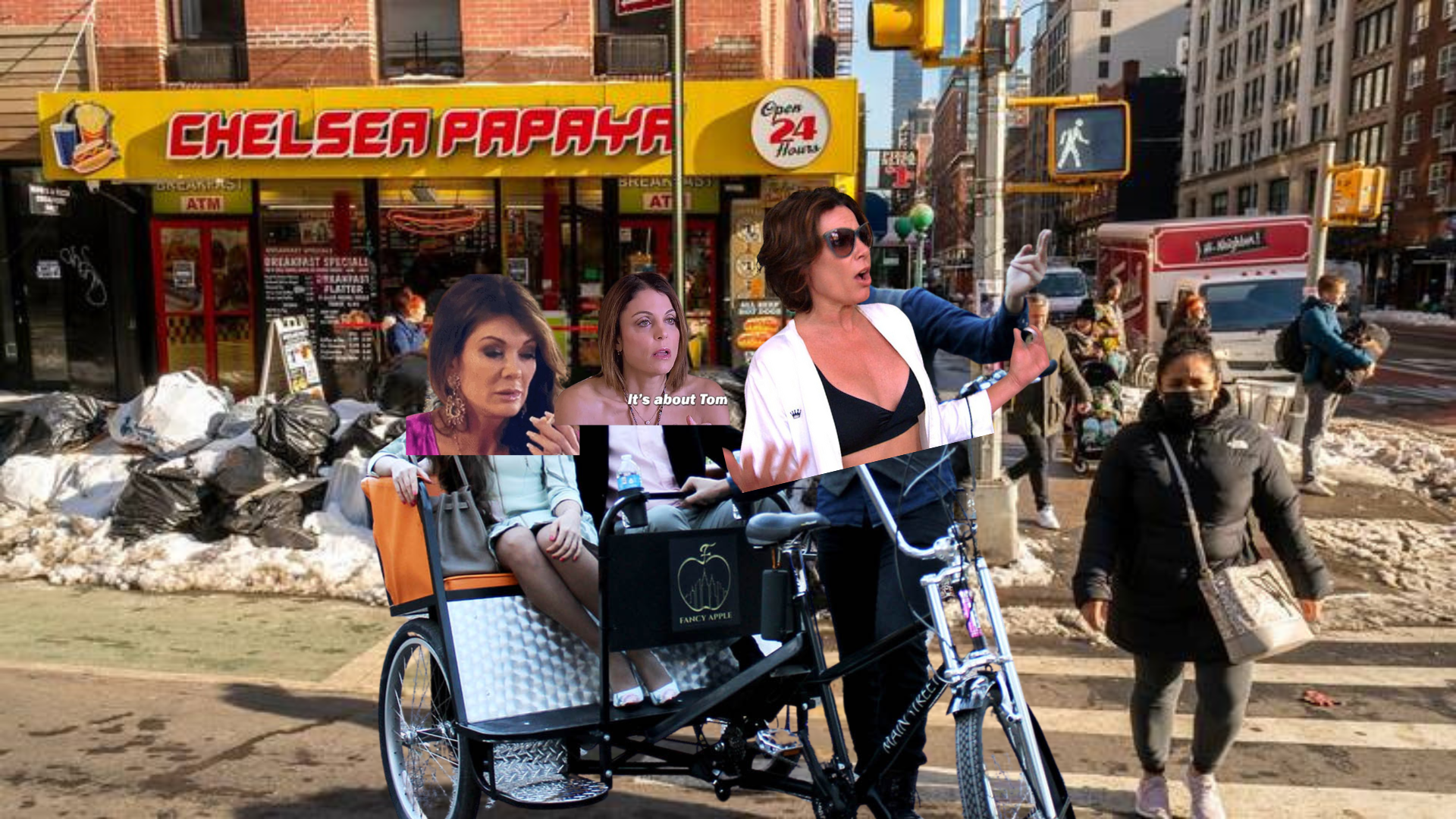
My first assignment in grad school was to report on a local news story. At first, I wanted to write about the lack of clean public restrooms in the city – but the expansion of pedicab drivers’ loud as fuck speakers became more of a glaring topic. Anyway- shoutout to Edward and Yisham. (September 30th 2024)
The bass shakes the streets, Jay Z’s Empire State of Mind blares, and LED lights flash—no, it’s not a nightclub, it’s the backseat of a pedicab in New York City. Reflecting the vibrancy of their surroundings, pedicabs have evolved to become not only faster, but louder and flashier. Motors, sound systems, and light shows—though technically illegal—are now common features. Once confined to Times Square and the Theater District, pedicabs are now spilling into residential neighborhoods like the Upper West Side, making their presence hard to ignore for both locals and tourists.
In early September, Mayor Eric Adams launched “Operation Front Door,” an NYPD-backed initiative aimed at ‘cleaning up’ Times Square, which the city touts as its metaphorical front door. On the first day, the NYPD confiscated over two dozen pedicabs, issued multiple summonses, and arrested several drivers. While crackdowns have continued, their long-term effectiveness remains uncertain, as nearly 2,000 drivers who rely on this trade continue to return to the streets for work. (The NYC Department of Consumer and Worker Protection, which manages pedicab licensing, did not reply for comment.)

Drivers like Edward, a long-time pedicab operator, are skeptical about the future.
“The city is changing,” Edward said. “I’ve lived here since 2010, and I don’t know, it’s going down.”
Originally from Russia, Edward came to New York City looking for work. Pedicabbing has been his career since his arrival—his bike provides cup holders and tour routes. Edward is both licensed and insured, despite having both a speaker and motor on his bike, which make him a target for NYPD enforcement.
Self-employed and lacking union representation, drivers’ opinions hold little weight in City Hall legislation. Speaking about Operation Front Door, Kaz Daughtry, NYPD Deputy Commissioner of Operations, specifically labeled pedicab drivers as a threat to New Yorkers’ quality of life. However, the swift crackdowns fail to address deeper systemic issues, such as high licensing fees, bureaucratic complexities, and regulatory loopholes. Instead, enforcement forces drivers to continue their work in a city that many see as increasingly unfriendly to those struggling economically.
Pedicabs first arrived in New York City in 1994 as a novel alternative to traditional yellow cabs. Though locals initially dismissed them as too expensive, tourists flocked to the new mode of transportation, eager for a unique way to see the city. By the late 2000s, their presence had grown enough to catch the attention of then-Mayor Michael Bloomberg, who attempted to impose regulatory measures in 2009 and 2011. These included customer safety rules and a cap limiting the number of pedicabs licensed to 850 per year. However, decades of lax enforcement allowed drivers to take advantage of loopholes and avoid oversight.
“It’s kinda gone downhill after the pandemic,” Edward reflected.
He considered 2016 to be his best year, when Bruce Willis took a ride in his cab, and he was featured on a YouTube channel’s stream. But the boom of the industry—and its challenges—reached a peak in 2024 when the NYPD issued nearly 1,500 criminal court summonses in just the first half of the year—a 120% increase from the same period in 2023. The sudden pressure on drivers came after years of neglect, with the city allowing the industry to grow unchecked until it became an unmanageable problem. Now Operation Front Door is struggling to enforce decades-old regulations, and many drivers find themselves caught in the middle of a bureaucratic nightmare.
Edward sees deeper roots to the issue. “It’s related to immigration, too,” he explained. “People come here, they don’t know what to do. It’s very easy to start pedicabbing, people rent them out illegally. No company. They are totally unregulated. Welcome to New York.”
On a sunny Monday afternoon in mid-September, about ten drivers stood at the West 72nd Street entrance to Central Park. Some held laminated maps, others snapped photos for tourists, and a few sat quietly on their bikes, waiting for customers. Despite the crackdown, every pedicab was motorized and equipped with speakers—two specific targets of the recent raids.
Among the bikes was a relatively modest cab, some tinsel and lights strung randomly. Yisham, its operator, donned an Adidas jacket and a worn-in Knicks baseball hat. Despite his city-issued rate-per-minute sign, Yisham typically offers rides for a flat rate. While the city forbids flat-rate pricing, drivers are allowed to set their own per-minute wage, which can range from $5.99 to as much as $10.99 per minute. This freedom to set rates draws potential drivers to the industry, although it is often a source of complaint for tourists who feel taken advantage of.
“I wouldn’t have got on, probably, if I knew the total price before,” said Lily, a tourist from Wales. “It was right fun, but maybe not that fun.” Lily and her six-year-old daughter Jane had been charged $100 for a twenty-minute tour of the park.

With a flash of his license, Yisham explains he emigrated from Egypt 36 years ago and has lived in New York ever since. For the past six years, he has been a pedicab driver. Before this, he worked as a travel agency manager, a career that allowed him to visit over 55 countries. Now, in his retirement, pedicabbing is his primary source of income.
“I live right behind the New Year’s ball in Times Square,” he says, chuckling. “But I’m not rich. I’ve had the same rent-controlled apartment for 36 years.”
Yisham explained that pedicabbing was a necessary shift to make ends meet in his later years. “It’s good for business, for work,” he reflected, “but not to raise a family. Everything is very expensive and small.”
The myriad of drivers like Yisham and Edward embody the spectrum of complexity that surrounds the pedicab issue—far from the ‘nuisance’ label given by city officials, both men consider the pedicab a necessary career. The divide between locals and tourists is clearly reflected in the pedicab industry. To tourists, pedicabs represent an iconic New York experience, a fun and unique way to see the city. But for locals, they have become a symbol of the city’s inability to manage new trends and industries effectively.
Short-term enforcement measures only scratch the surface of a problem with much deeper economic, social, and political roots. Drivers like Edward express frustration not only with the enforcement but with how it reflects broader issues like displacement, lack of opportunities for immigrants, and the growing divide between the city’s policies and its working-class residents.
New York City can only rise to the challenge of managing pedicabs by rolling out effective regulations from the start and offering legitimate opportunities for drivers. Rather than relying on heavy-handed crackdowns, the city should implement more thoughtful, targeted regulations that balance the needs of tourists, locals, and drivers alike. This could include streamlining the licensing process, creating clearer guidelines for the use of motors and sound systems, and addressing the root causes that drive many immigrants into the pedicab industry in the first place.
Whether through new regulations, compromises, or further crackdowns, the fate of pedicabs will continue to reflect broader questions about how New York manages its diverse, ever-growing population. Only time will tell what direction the city takes, but for now, the streets remain their stage.